Michelin CrossClimate2 vs. Goodyear Assurance WeatherReady2
Both are year-round tires with severe-snow-service markings. We compare their published specifications and a real same-size Tire Rack head-to-head test, while explaining what those results can—and cannot—tell you about your own driving.
Ready to shop? Compare these tires.
Choose your confirmed tire size to check exact-size Tire Rack offers. Different sizes of the same model have different SKUs.
Affiliate disclosure: We may earn a commission from qualifying retailer purchases at no extra cost to you. Verify retailer fitment, current stock and price.
Check the driver-door placard. Do not guess tire size.
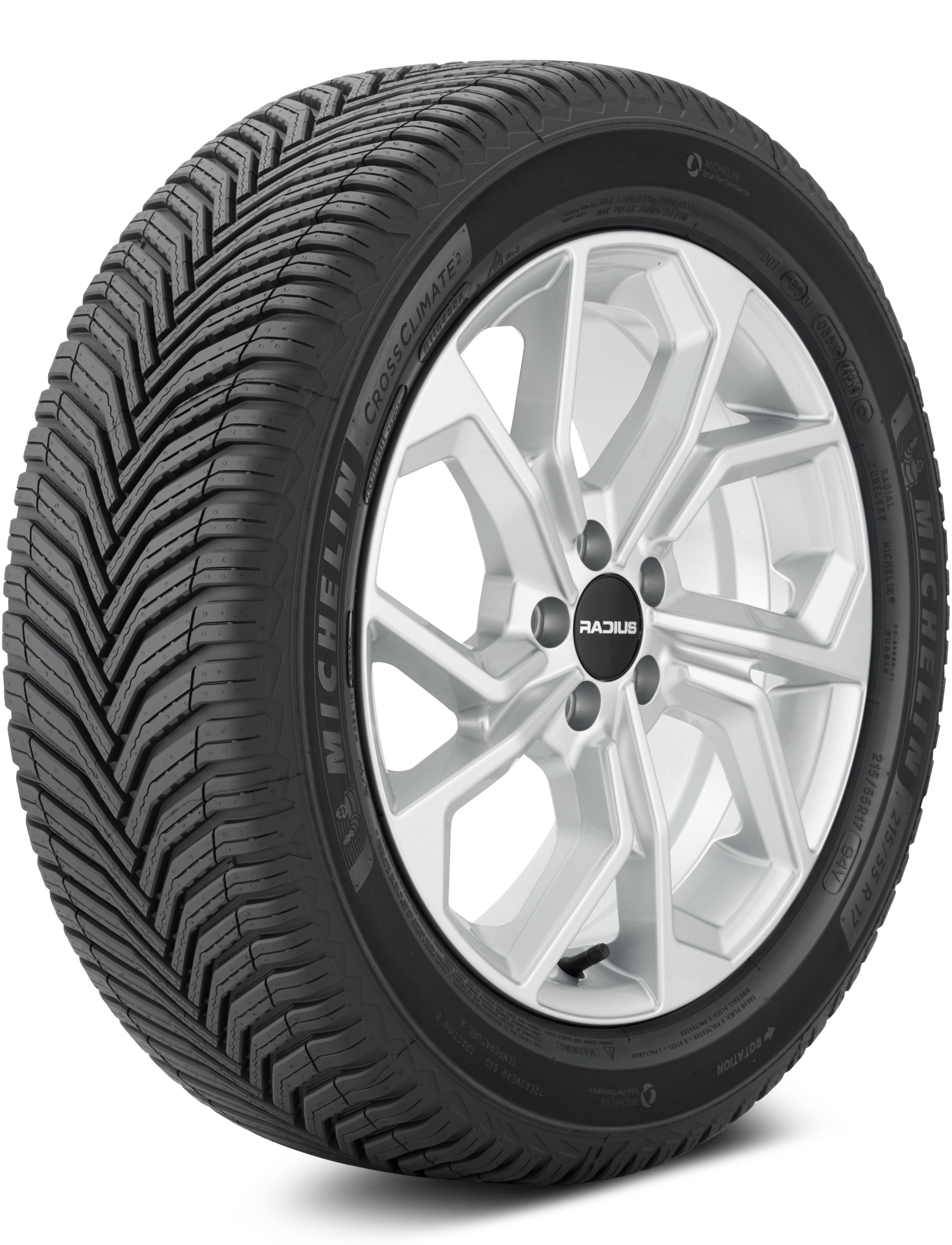 Image source: The Tire Rack via CJ (representative model image)
CrossClimate2
Best for: Year-round drivers who want added winter capability without a seasonal tire swap.
A premium all-weather option for mixed seasons and regular highway use.
Popular sizes: 225/60R17, 235/55R18, 245/45R19
Strengths: Year-round category · Snow-rated designation
Tradeoffs: Premium positioning · Not a substitute for a dedicated winter tire in every situation
Fitment check: Listed sizes are research context, not a guarantee. Confirm the vehicle placard, load rating, speed rating, and retailer fitment before ordering.
 Image source: The Tire Rack via CJ (representative model image)
Assurance WeatherReady2
Best for: Four-season commuting with meaningful snow capability.
An all-weather touring choice aimed at drivers facing changing Black Hills conditions.
Popular sizes: 225/60R17, 235/55R18, 245/50R20
Strengths: Snow-rated designation · Touring-oriented use
Tradeoffs: Costs more than many conventional all-season tires · Dedicated winter tires remain the stronger severe-winter choice
Fitment check: Listed sizes are research context, not a guarantee. Confirm the vehicle placard, load rating, speed rating, and retailer fitment before ordering.
Need the right size? Use the tire-size finder or browse more tires.
Where each tire has the edge
In Tire Rack’s 2024 group test with a winter update, both were evaluated in 215/55R17 94V SL on a 2025 Toyota Camry. These are advantages in that particular test, not guaranteed rankings for every size or vehicle.
Michelin CrossClimate2
Snow braking: 56 ft vs. Goodyear’s 61 ft from 25 mph.
Ice braking: 46 ft vs. Goodyear’s 51 ft from 12 mph.
Dry braking: also shorter in this test, 127 ft vs. 130 ft from 60 mph.
Goodyear WeatherReady2
Wet handling lap: 33.79 seconds vs. Michelin’s 34.40 seconds. Lower was faster.
Everyday comfort: Tire Rack’s testers preferred its ride comfort in this group test. That’s a subjective driving impression, not an objective braking measure.
Test source: Tire Rack, “Premium Touring Tires to Elevating the Journey,” 2024 Test 8 with Winter Update. Tire Rack is an affiliate retailer partner; these are its reported measurements, not tests performed by Black Hills Tire Guide. Tire conditions, vehicle, surface and tested size affect results.
Which is better for you? Start with the job, not the brand
Short answer: There is no universal winner. For a driver who wants one tire set through rain, dry pavement and occasional snow, both deserve consideration—provided the exact size and service description match the vehicle. For frequent severe ice, steep unplowed roads or sustained cold-weather travel, compare a dedicated winter tire as well. Do not assume any 3PMSF-marked all-weather tire equals a specialized winter tire on ice.
The CrossClimate2 has a distinctive directional tread concept marketed by Michelin and a published 60,000-mile limited treadwear warranty. Goodyear positions WeatherReady2 around wet-weather water/slush evacuation, its wear gauge and a published 60,000-mile limited treadwear warranty. Those are manufacturer descriptions, not our own road-test findings.
CrossClimate2 vs. WeatherReady2: the relevant published facts
| Decision factor | Michelin CrossClimate2 | Goodyear Assurance WeatherReady2 |
|---|---|---|
| Category | Year-round all-season product marketed with severe-snow capability | Year-round all-weather-focused product marketed with severe-snow capability |
| 3PMSF on manufacturer’s product page | Yes | Yes |
| Published treadwear warranty | 60,000 miles; exclusions and conditions apply | 60,000 miles; exclusions and conditions apply |
| Design emphasis | Year-round braking and longevity claims from Michelin’s testing | Water/slush-management grooves and evolving traction-groove design |
| Exact replacement fitment | Check size, load index, speed rating and approved application | Check size, load index, speed rating and approved application |
| Ice braking in cited 215/55R17 test | 46 ft from 12 mph — Tire Rack result | 51 ft from 12 mph — Tire Rack result |
Read the fine print: a mileage warranty is a limited manufacturer program, not a prediction that every driver will achieve that mileage. Manufacturer performance comparisons can use different reference tires and test methods. A tire in the same model family may also have size-specific load and speed ratings.
What does 3PMSF actually tell you?
The three-peak mountain snowflake (3PMSF) symbol indicates a tire has passed a specified snow-acceleration traction threshold. It is a useful screening tool, especially when comparing to ordinary M+S-labeled touring tires. But that particular qualification test does not establish a tire’s ice braking, dry braking, deep-snow flotation or cornering performance. Tire Rack’s all-weather tire explainer describes these limits clearly.
For much of the United States, where winter conditions come and go and storage for two sets is impractical, an all-weather tire can be a sensible compromise. A household in a location with prolonged freezing temperatures, regularly snow-packed roads or frequent ice should separately evaluate dedicated winter tires. The right answer depends on the actual commute, road maintenance and willingness to switch tires seasonally.
Also verify the exact tire: don’t rely on a general model description to guarantee the approval markings, size or specification of the specific SKU at checkout.
Which option fits your driving pattern?
Daily commuting with rain and occasional snowfall
Compare prices and installed cost for both models in your exact size, then prioritize the required service rating, warranty terms, owner priorities and availability. In Tire Rack’s same-size test, Goodyear ran the wet handling lap faster; measured wet braking distances were equal. That does not guarantee identical outcomes in another size or on another vehicle.
Crossovers and family SUVs
Start with the driver’s placard or manufacturer specifications. Crossovers often have specific load-index and XL requirements. Confirm that each candidate matches or exceeds required ratings, and do not equate a matching wheel diameter with verified vehicle fitment. Our tire-size finder provides a useful starting point; the retailer must confirm final application.
Regular mountain trips, ice and unplowed roads
First decide between one year-round set and a dedicated winter set. If you encounter persistent ice, the traction compromises may matter more than a warranty difference. Drivers in the Black Hills should also consult our South Dakota winter tire guide and current road conditions before travel.
Drivers comparing price and total value
Calculate total installed cost, including mounting, balancing, tire disposal, applicable taxes and TPMS work; then consider availability, warranty exclusions, expected annual mileage and seasonal changeover costs. We do not display stale or estimated retailer prices as current quotes.
Before ordering either tire online: the 7-point checklist
- Read the door placard: record the tire size and original load specification; check the owner’s manual for approved alternatives.
- Compare the exact SKU: confirm tire width, aspect ratio, rim diameter, load index, speed rating and SL/XL designation.
- Verify the actual 3PMSF marking: review the tire’s manufacturer or authorized retailer specifications.
- Choose the right season strategy: consider whether a dedicated winter set makes more sense for ice or sustained snow.
- Check availability at checkout: model-level catalog displays do not guarantee that a particular tire size is stocked.
- Price the complete installation: verify whether the installer accepts customer-supplied online tires and what the service includes.
- Protect your purchase: keep receipts and registration details; inspect tire condition and production-date marking when received.
Don’t simply replace a required XL tire with a standard-load tire of the same dimensions. The tire-size guide explains the basic markings, and a qualified tire technician can confirm service requirements.
Compare both models in your size
Our existing tire catalog includes Michelin CrossClimate2 and Goodyear Assurance WeatherReady2. Choose the precise tire size in Shop Tires; only matched, verified retailer offers display purchase links.
Browse all-weather tires →
Find my tire size →
Compare tire types →
Affiliate disclosure: We may earn a commission from qualifying purchases through retailer links, at no additional cost to you. Please verify fitment, final retailer price and availability.
Frequently asked questions
Is Michelin CrossClimate2 a winter tire?
It is marketed as a year-round all-season tire and bears the 3PMSF symbol. That does not make it identical to a dedicated winter tire on ice or in every cold-weather test.
Is WeatherReady2 the same tire as the original WeatherReady?
No. WeatherReady2 is a different product generation. When reading test results, check that the tested tire is actually WeatherReady2 rather than the previous Assurance WeatherReady.
Can I use either tire on my AWD vehicle?
Potentially, if the correct size and load/speed requirements are met. Many AWD systems also have limits on mismatched tire circumference and tread depth; review the manufacturer guidance before replacing one or two tires.
Does 3PMSF guarantee good ice braking?
No. The snow-service certification does not include an ice-braking test. Dedicated winter tires deserve separate consideration for frequent ice.
Sources and verification notes
Manufacturer descriptions checked October 2026. This article compares published specifications and selection criteria; it contains no in-house comparative road test.
Affiliate disclosure
Black Hills Tire Guide may earn a commission when you purchase through qualifying retailer links, at no additional cost to you. Affiliate relationships do not determine our tire safety recommendations. Pricing, stock and fitment must be confirmed with the retailer and installer before purchasing.